Winning Loose Pucks: The Biomechanics of First-Three-Stride Acceleration
Hockey games aren't decided in straight-line marathons—they are decided in the first 10 to 15 feet to a loose puck. Here is the exact physics of explosive first-step separation.
By Jessica Kooreman (2x Olympian) & Mike Kooreman (2x Olympic Coach) • Updated 2026-11-23
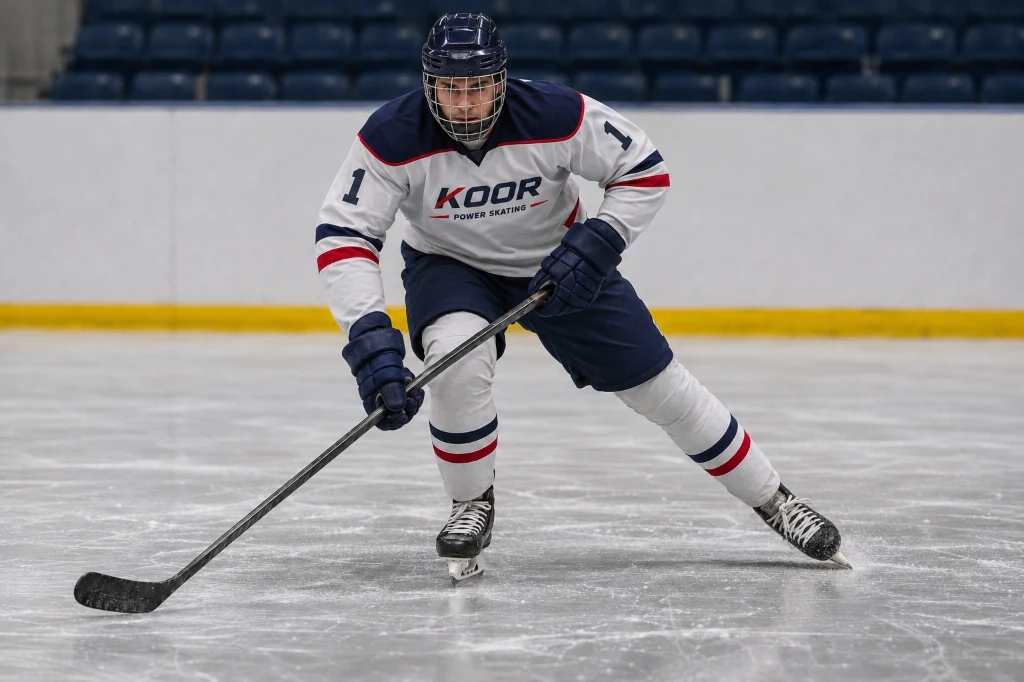
Why Spinning Your Feet Wastes Your First Step
Watch a youth game closely and you will see dozens of players pumping their legs furiously on a start while going almost nowhere for the first second. That happens when a skater stands too tall and tries to run on their blades without establishing firm inside-edge bite into the ice.
True acceleration requires a decisive angled blade placement combined with deep knee and ankle flexion so every ounce of leg extension pushes the body forward down the sheet.
From Static Start to Game-Speed Crossover
Once the first two driving steps break inertia, elite skaters transition seamlessly into powerful V-strides and crossovers rather than abruptly popping upright. In our acceleration labs, we pair rapid starts with immediate edge transitions and puck touches so explosive first-step mechanics become automatic during board battles and breakouts.
Want KOOR to Coach These Mechanics at Your Team's Next Practice?
We travel directly to your scheduled team ice anywhere in Metro Detroit & Southeast Michigan—no extra rink rental required.
More Skating Science Guides
All GuidesTop-End Speed & Efficiency
Why Hockey Players Slow Down in the 3rd Period (And How Efficiency Fixes It)
Late-game fatigue isn't always a conditioning problem—most players lose speed in the 3rd period because wasted upper-body motion and shallow stride mechanics drain energy twice as fast.
For Team Coaches
What Youth & Travel Hockey Coaches Should Look For in a Team Power Skating Session
Effective team power skating isn't running cones around the perimeter—it's integrating biomechanical stride, edge, and transition corrections directly into your team's real game habits.