What Youth & Travel Hockey Coaches Should Look For in a Team Power Skating Session
Effective team power skating isn't running cones around the perimeter—it's integrating biomechanical stride, edge, and transition corrections directly into your team's real game habits.
By Jessica Kooreman (2x Olympian) & Mike Kooreman (2x Olympic Coach) • Updated 2026-11-23
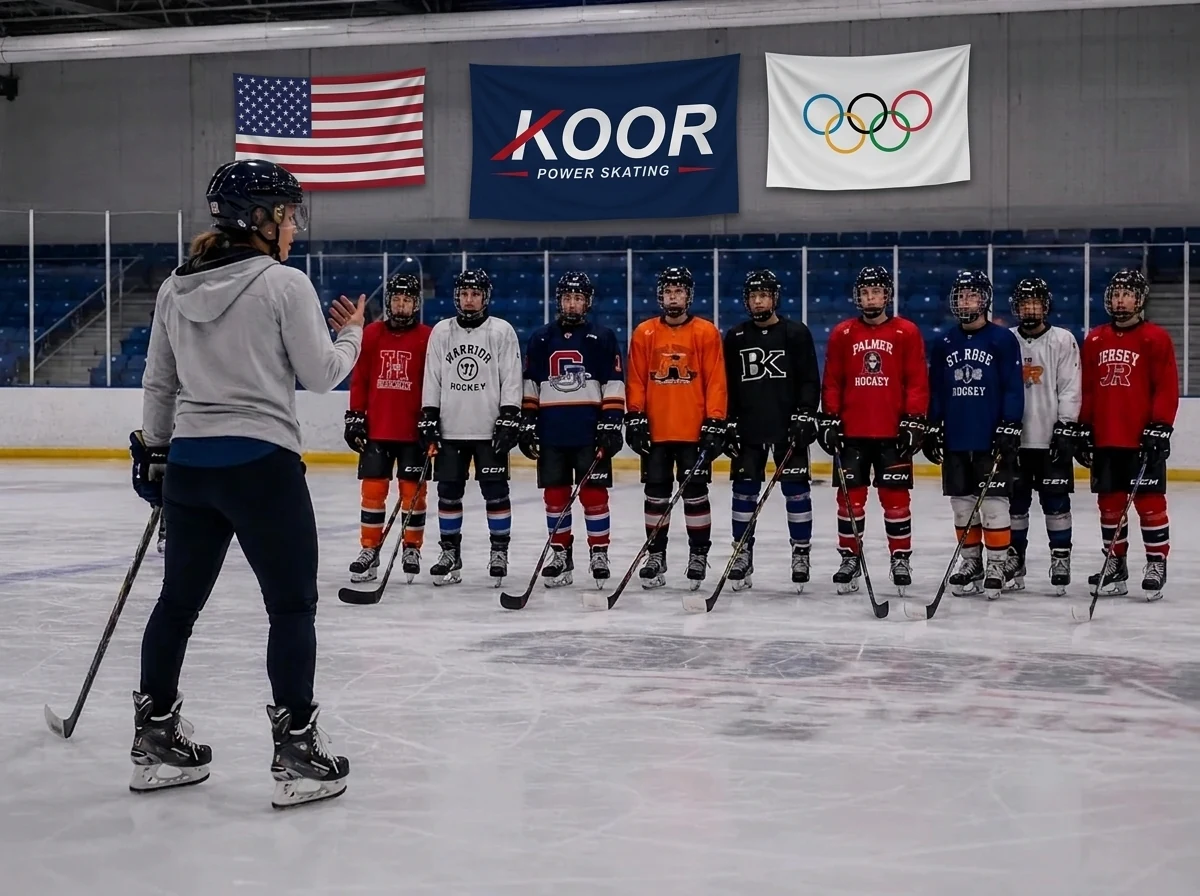
1. Mechanical Feedback Over Conditioning
If an instructor puts 18 skaters in a continuous line without stopping to correct shin angle, weight distribution, or blade contact, players simply reinforce bad habits faster. Look for coaches who explain the 'why' behind edge pressure and adjust individual posture in real time.
2. Seamless Integration With Your Practice Plan
Metro Detroit youth and travel hockey teams already spend thousands on prime-time ice slots. The cleanest model brings elite skating specialists directly onto your scheduled weekly practice so your entire roster builds unified speed, starts, and edge control without renting an extra hour of ice.
3. Age-Appropriate & Position-Specific Progression
A 10U Squirt squad working on foundational knee bend and outside edges needs a different session plan than a 16U AAA team refining backward-to-forward blue-line pivots and puck-protection escapes. At KOOR, we map every team visit directly to your coaching staff's priorities before stepping on the ice.
Want KOOR to Coach These Mechanics at Your Team's Next Practice?
We travel directly to your scheduled team ice anywhere in Metro Detroit & Southeast Michigan—no extra rink rental required.
More Skating Science Guides
All GuidesTop-End Speed & Efficiency
Why Hockey Players Slow Down in the 3rd Period (And How Efficiency Fixes It)
Late-game fatigue isn't always a conditioning problem—most players lose speed in the 3rd period because wasted upper-body motion and shallow stride mechanics drain energy twice as fast.
Explosive Acceleration
Winning Loose Pucks: The Biomechanics of First-Three-Stride Acceleration
Hockey games aren't decided in straight-line marathons—they are decided in the first 10 to 15 feet to a loose puck. Here is the exact physics of explosive first-step separation.