Why Hockey Players Slow Down in the 3rd Period (And How Efficiency Fixes It)
Late-game fatigue isn't always a conditioning problem—most players lose speed in the 3rd period because wasted upper-body motion and shallow stride mechanics drain energy twice as fast.
By Jessica Kooreman (2x Olympian) & Mike Kooreman (2x Olympic Coach) • Updated 2026-11-23
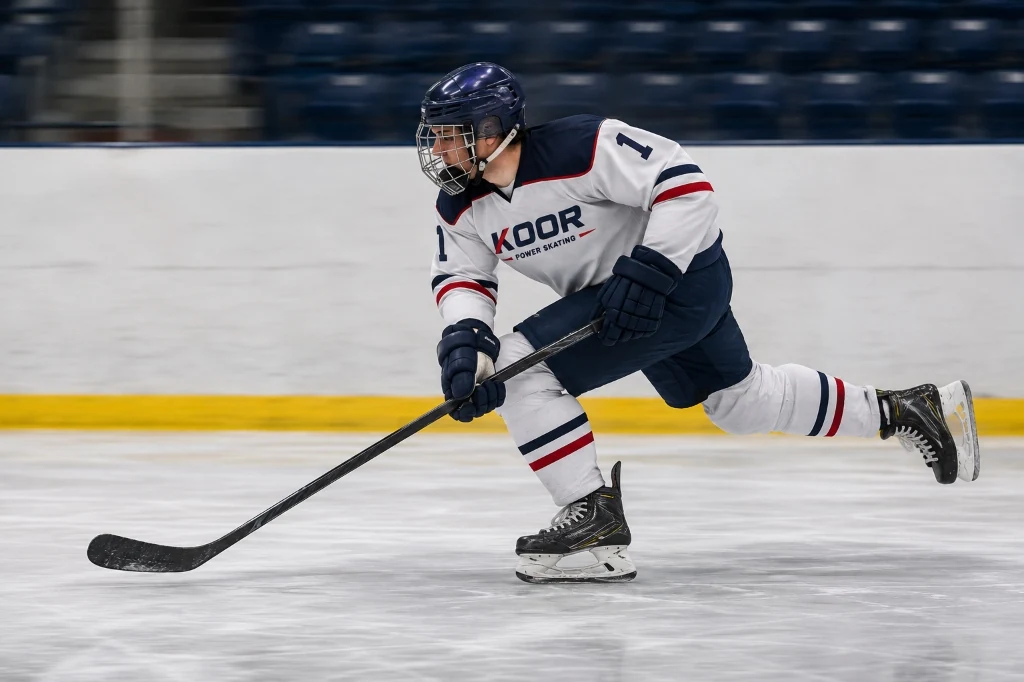
Speed Loss Is Usually Mechanical Before It Is Cardiovascular
When a 12U, 16U, or high school hockey player looks visibly slower in the third period, coaches often prescribe extra conditioning skates. Yet in many cases, the athlete's lungs aren't the primary bottleneck—their skating posture is.
As soon as fatigue sets in, players naturally lift their chest and straighten their knees by just a few inches. That small posture shift cuts stride length dramatically, requiring more choppy steps to cover the exact same distance across the ice.
What Olympic Short Track Teaches Hockey Players About Glide
At the Olympic level, races are won by millimeters and hundredths of a second—meaning wasted motion cannot exist. Every push must drive force cleanly into the ice at the proper edge angle, followed by a quiet upper body and a complete leg recovery directly back under the player's center of mass.
When hockey players learn to load their hips, keep their torso stable, and let each stride glide cleanly before firing the next push, they generate higher top speed with significantly lower muscular cost.
Building 3rd-Period Habits at Team Practice
Fixing late-game speed doesn't mean skating players into exhaustion with bag skates. During KOOR team practice sessions, we isolate stride extension, ankle flexion, and recovery tracking early in practice, then apply those exact cues at high tempo so proper mechanics hold up under 3rd-period and overtime pressure.
Want KOOR to Coach These Mechanics at Your Team's Next Practice?
We travel directly to your scheduled team ice anywhere in Metro Detroit & Southeast Michigan—no extra rink rental required.
More Skating Science Guides
All GuidesFor Team Coaches
What Youth & Travel Hockey Coaches Should Look For in a Team Power Skating Session
Effective team power skating isn't running cones around the perimeter—it's integrating biomechanical stride, edge, and transition corrections directly into your team's real game habits.
Explosive Acceleration
Winning Loose Pucks: The Biomechanics of First-Three-Stride Acceleration
Hockey games aren't decided in straight-line marathons—they are decided in the first 10 to 15 feet to a loose puck. Here is the exact physics of explosive first-step separation.